I grew up in a broken home. The abuse from my father, religious ideology, technology, and my own childhood need for love and stability all played a role in what happened to me: a forced child marriage.
About this audio
This edition uses AI-generated narration and is not Bee’s voice. The testimony is presented in Bee’s words, with evidence passages added for context. Open the audio directly.
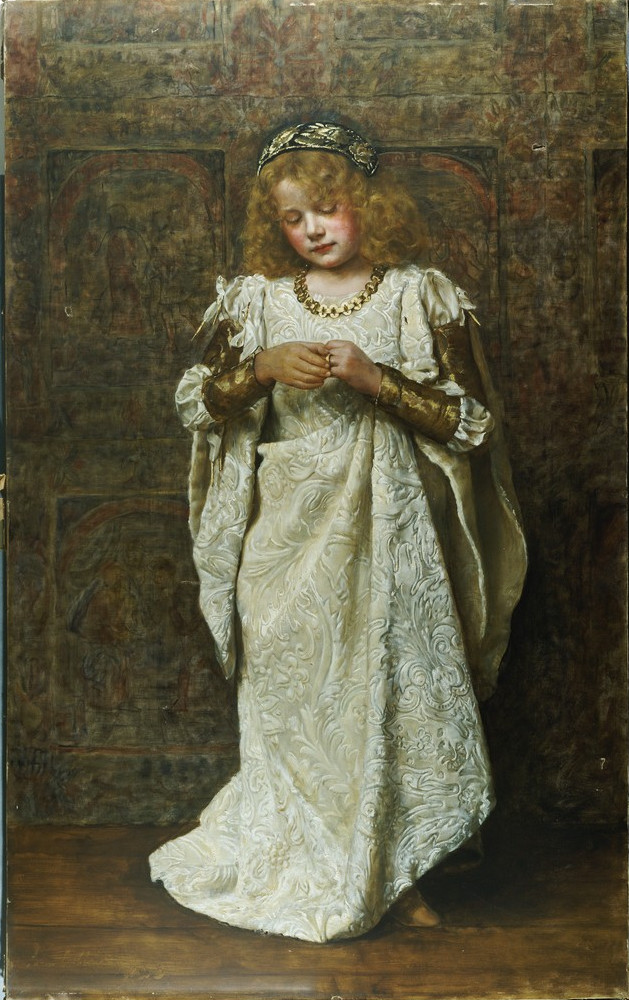
Before the license, a child is asked to inhabit an adult role.
John Collier · The Child Bride · 1883Bee’s story · Chapter 01
A childhood divided
Before the marriage license, there was a child searching for a place that felt safe.
I grew up in a broken home. My parents divorced when I was four. I am one of ten children from two marriages—the eldest daughter of five girls and the fourth child born to my mother. Divorce, family court, custody agreements, my father’s military service, and religion all made childhood chaotic.
When my mother finally left my abusive father after ten years and five children, she had no education, money, or help. My father accused her of neglect. She eventually lost custody. Three times a year, four of us flew across the country as unaccompanied minors between wherever my father was stationed and Salt Lake City, where my mother lived.
On one of those visits, I met my eldest brother’s teenage friend. I’ll call him John. He is the man I would later be forced to marry.
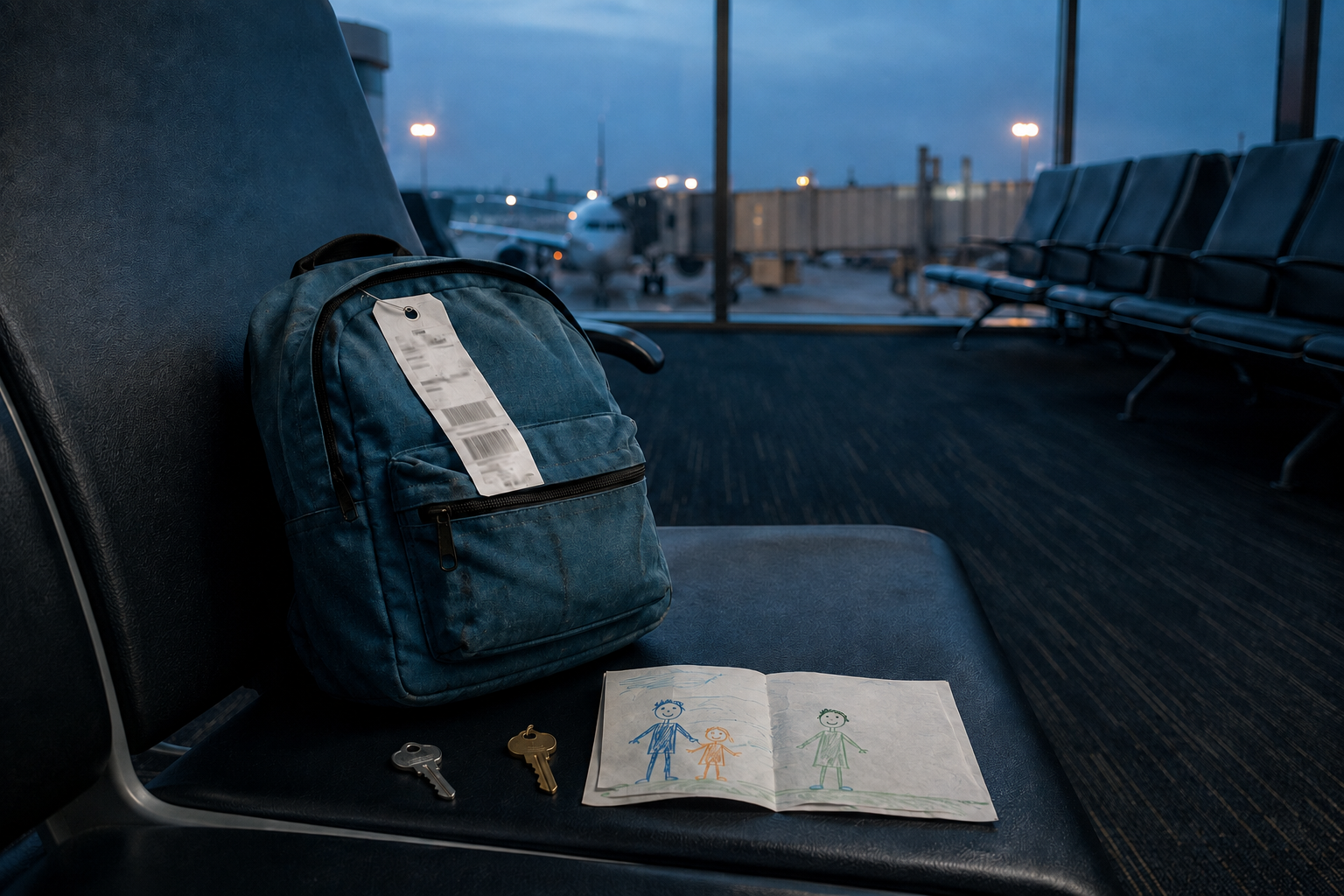
Salt Lake City ↔ wherever my father was stationed
Three school breaks a year.
Four children flying alone.
Every arrival meant another goodbye.
Bee’s story · Chapter 02
Groomed from thirteen
Attention can feel like rescue when a child has been taught to expect abandonment.
I was ten when we met. John already had a baby son and a marriage behind him. During his second marriage, when I was thirteen, he began paying me attention I did not understand. He told me I was growing up fast. That I was more beautiful than he remembered. No one had said things like that to me before.
John was twenty when he groped me during video-game night. He showed me how to install Kik on my iPod, then messaged constantly: you’re so amazing, I wish I could be with you. He manipulated a little girl who wanted, more than anything, to be wanted. It went on for years, escalating into what is now recognized as the internet luring and exploitation of a child.
After he left his second wife and the military, the abuse intensified. I slept fifteen to eighteen hours a day. I stopped going to school. My father pulled me out to “homeschool” me.
“I was a little girl starving for attention. He made exploitation feel like love.”

The room was dark. The messages kept coming.
The device fit in my hand.
The attention filled the room.
Years before adults around her named it, the pattern already had a name: grooming.
One child’s storyA national pattern
Evidence pause · The scale
This was not an outlier.
Marriage-certificate data studied by Unchained At Last document a national pattern. The estimate almost certainly undercounts religious-only marriages and missing records.
314,154
minors legally married in the U.S., 2000–2021
86%
were girls; most married adult men
Those men were an average of 4.02 years older.
96%
were age 16 or 17
But recorded marriages included children as young as ten.
Bee’s story · Chapter 03
Taken across state lines
At sixteen, fear narrowed every choice until leaving felt like the only one.
John texted in the middle of the night to say he was coming to tell my father everything and take me away. I was terrified of what my father would do if he learned what had happened. The next morning, I let John take me away in his white Chevy Cobalt.
He drove me to his parents’ house in Utah, where I was hidden under a bed, in a closet, and in his car—sometimes going a full day without food or water. He made me provide childcare and insisted I “pitch in” for room and board. When I took a movie-theater job, police found me hiding beneath the popcorn counter, repeating, please don’t let him take me.
They asked whether I had slept with the man I left with. I said nothing. “It’s not illegal here in Utah,” they told me, “as long as he isn’t ten years older than you.” They returned me to the adults who came to collect me. Back in Colorado, I was cut off from school, work, the phone, and the internet. That was when I made my first suicide attempt.
What happened to BeeWhat the law permitted
Evidence pause · The legal trap
Too young to leave. Old enough to be bound.
Marriage can trigger adult legal status in some contexts while a minor remains practically dependent in others. The result is not liberation—it can be a maze.
When the law says “wife”
Select a barrierLegal marriage did not give her the tools to escape it.
Choose one of the systems a married child may need in order to leave safely.
The contradiction: recognised as married; still denied many of an adult’s practical rights.recorded child marriages met the age and age-gap definitions of a sex crime in the relevant state—yet the marriage itself was legal.
Bee’s story · Chapter 04
“You’ll be married in the morning”
A signature made the control legal. It did not make it consent.
Weeks later, a lifeguard course gave me access to email. John’s messages filled my inbox. I sent one reply with the time and place of my final class. He was waiting when I walked out. He drove me home, saying he would speak to my father “man to man.”
That night, my father told me John would sleep at my aunt’s house. “In the morning, you and John will be right with God.” John explained by text: We came to an agreement. Tomorrow, we’ll be married.
I cried through the night, trying to understand what it meant to be married at seventeen with no diploma, no job, and no money. At 9 a.m., we drove to the El Paso County DMV. A clerk asked for my ID and issued my father the marriage license.
In our living room, my father slid a crude ring onto my finger—a crystal pendant from a necklace I had given my stepmother, dismantled and repurposed. He pronounced us husband and wife under the authority of the church and “Patriarch of this home.” I signed. I got into the white Chevy Cobalt and waved goodbye.
Ten minutes later, John stopped in an empty church parking lot. “You belong to me now. Legally,” he said. He raped me. Then I sat with what he had done for the ten-hour drive to Salt Lake City, where I would be his wife for the next year and a half.
“You belong to me now. Legally.”

El Paso County · age seventeen
No diploma. No job. No money.
By morning: a legal husband.
The paper changed her legal status. It did not create consent.
Seven years · four numbers
Childhood narrowed one age at a time.
met him
a teenage friend of my eldest brother
An old silence in modern law
The silence is old. The practice should be history.
Collier makes the contradiction visible: the gown gives a child an adult role while the small figure inside it remains unmistakably young. She stands alone, looking down, almost swallowed by a ceremony shaped by other people.
This is not Bee. It was painted in Britain in 1883. It appears here as a historical counterpoint: child marriage belongs to a world that gave families, husbands and institutions more authority over girls than girls possessed over themselves. Its survival is not a tradition to protect, but an outdated legal remnant to end.
View the public-domain work and record ↗Evidence pause · After the license
The consequences can last long after the marriage ends.
more likely to leave high school
Compared with peers who marry after childhood.
less likely to complete college
Education loss compounds financial dependence.
past-year psychiatric disorder
Among women married before 18, versus 27.65% among women married as adults in one national study.
Read this carefully: the mental-health study identifies an association, not proof that early marriage alone caused every outcome. The pattern remains significant after adjustment for demographic factors.
Bee’s story · Chapter 05
Finding my voice
Years later, another survivor’s decision to speak became a door.
In January 2023, I saw Christian Griffith on The Selection: Special Operations Experiment. Under interrogation, he said he was a survivor of child sexual abuse and would never stop raising awareness. He cried. I cried with him from my couch.
I found the campaign he had started and something shifted. The next day I ran around my neighborhood. I told my spouse about an idea: swim, bike, and run 3,000 miles to raise awareness of child marriage in the United States. In February, I made the campaign public and began fighting for my sobriety. I have been speaking ever since.
Before leaving TikTok, I received messages from survivors, families, and children born to survivors. Speaking out has carried me into newsrooms and committee hearings. It has exhausted and encouraged me in equal measure. Telling my story without shame cracked my self-esteem open and filled it with something new: self-love, forgiveness, and a strength I did not know I had.
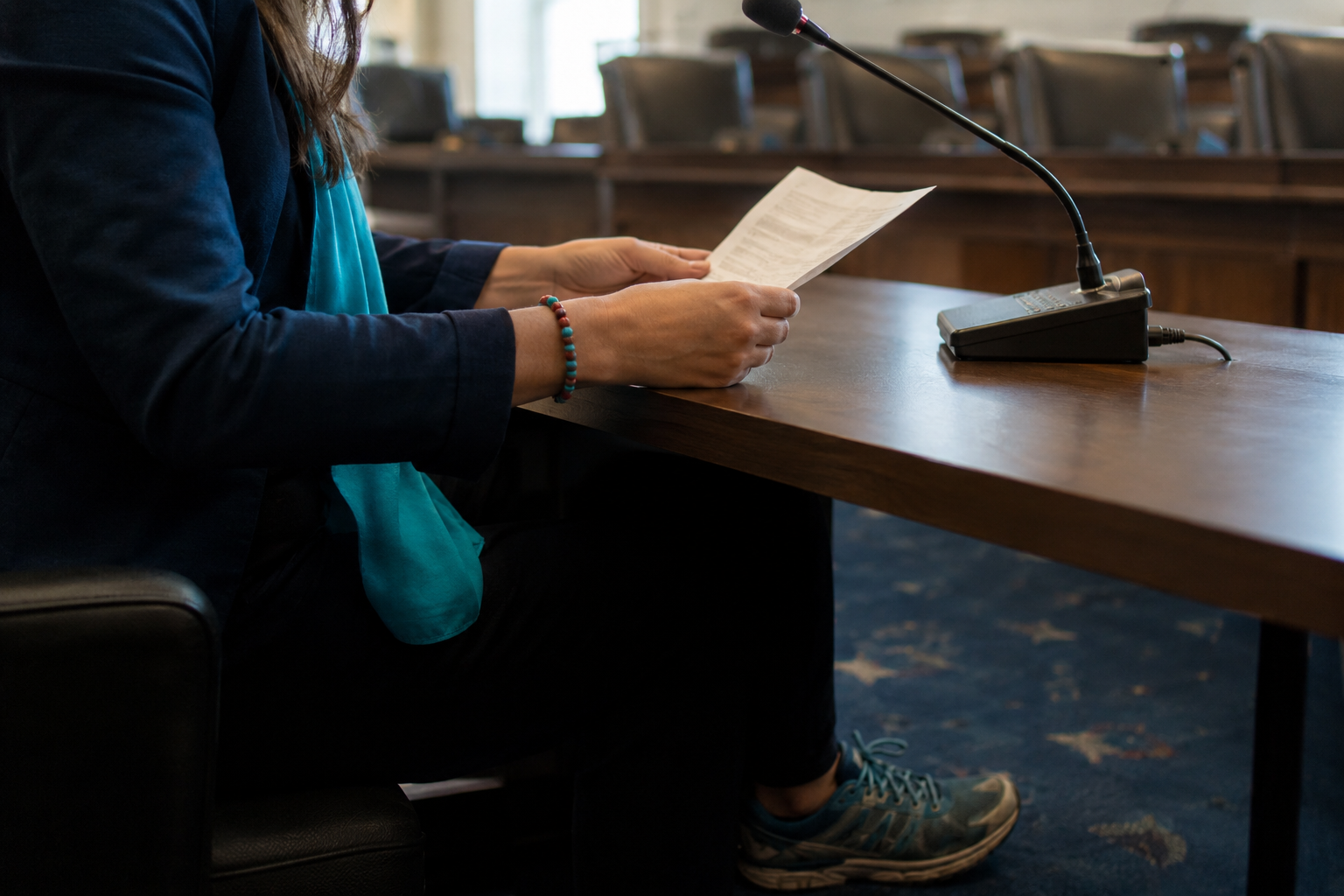
Finding my voice
At twenty-seven, I learned
what happened to me had a name.
The same story that once isolated Bee now helps other survivors recognize their own.
Bee’s story · Chapter 06
Testifying in Colorado
The state holds my worst memories and some of my best. I want it to be safe for every child.
After I escaped, I returned to Colorado, tested for my GED, joined the Army Reserve Military Police Corps at Fort Carson, remarried, and had a daughter. Raising the marriage age to eighteen, without exceptions, felt like the place to start.
At the Senate hearing on February 17, 2026, opponents argued that anyone married under Colorado’s current 2019 law would only be about twenty-three. I thought about myself at twenty-three: recovering from my third suicide attempt, newly diagnosed with PTSD, in military training, still fighting for an education. I did not understand until I was twenty-seven that what happened to me had a name and was happening across the country.
What shocked me was who I understood to be opposing the bill, including organizations I expected to stand against child marriage. We are not only fighting a law. We are fighting the willingness to look away from the evidence.
“Expecting a twenty-three-year-old to have already healed enough to fight this fight is abhorrent.”
average underage-marriage cases per year requiring a guardian ad litem appointment
Evidence pause · A live policy fight
SB 26-048 began as a full ban. It did not survive that way.
The introduced bill would have raised Colorado’s marriage age to 18 with no exceptions. Bee testified before the Senate State, Veterans, & Military Affairs Committee on February 17, 2026.
Source: Colorado General Assembly
The bill’s path · 2026
How a bright line became another exception.
Introduced
No marriage under age 18.
Survivors testify
The Senate committee hears the bill and advances it.
Amended
A House committee replaces the full ban with a rule allowing 16- and 17-year-olds to marry someone less than ten years older.
House passes
The narrowed bill returns to the Senate.
Senate vote
The Senate concurs with the House amendments, 18–17, then fails to repass the bill, 11–24. The bill is lost.
Sources: official bill history and final fiscal note
Where the law is moving
17 states have enacted an age-18, no-exceptions law.
Oklahoma became the seventeenth in 2026; its law takes effect November 1. That progress means millions of children live behind a clear legal line. It also leaves most states with some path to child marriage.
Sources: Unchained At Last and the Oklahoma Senate
Chapter 07 · What helped me heal
Being seen for the life I had actually lived.
Unchained At Last has been the greatest support in my journey from victim to survivor. About a year after I began speaking out, I flew to San Jose for one of the organization’s “chain-in” events.
When I walked into the room, it went quiet. The survivors and advocates already there recognized me. For the first time, I felt truly seen—not for the version of me others had demanded, but for the life I had lived.
“Telling my story without shame has filled me with self-love, forgiveness, and a strength I didn’t know I had.”
The law once told Bee that a license could turn a child into a wife.